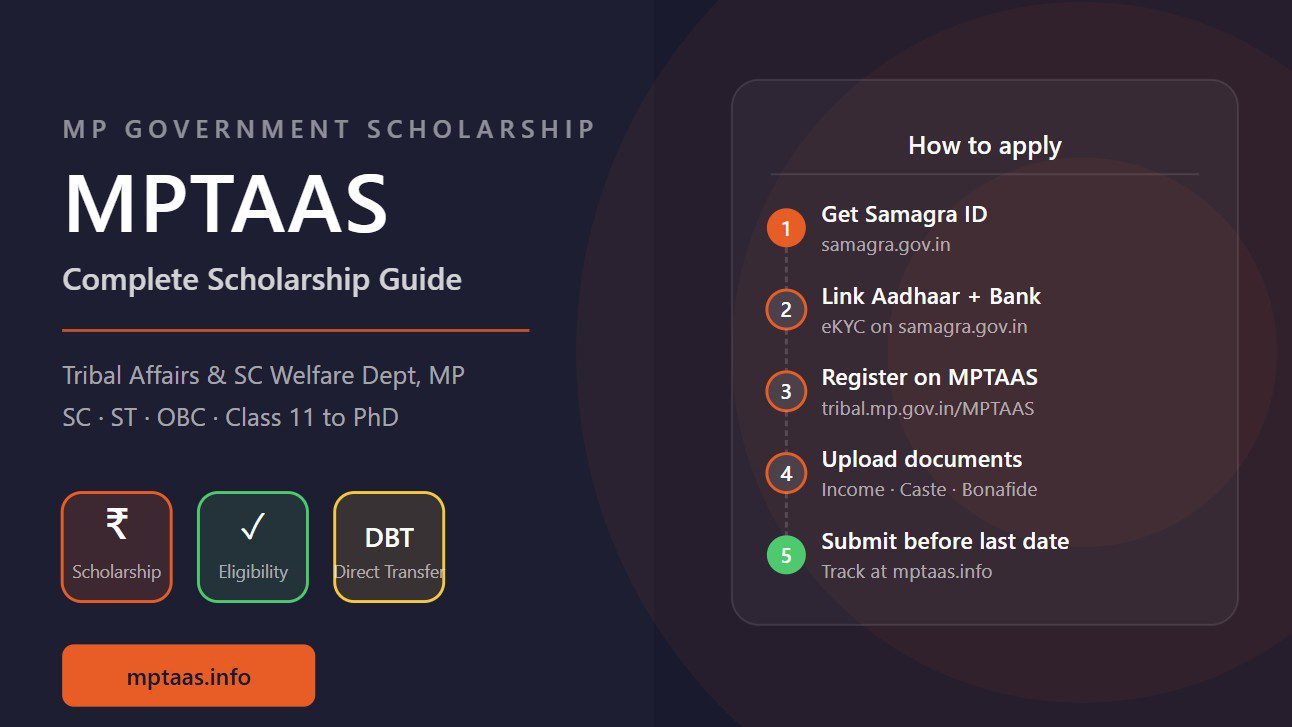
The direct answer — you cannot apply for MPTAAS scholarship without Samagra ID. Samagra ID is mandatory with no exceptions. However, getting your Samagra ID is faster than most students expect. This guide shows the quickest path to getting one and applying before the scholarship deadline.
Why MPTAAS Requires Samagra ID
MPTAAS uses Samagra ID to verify MP residency, confirm caste category without re-verification, and prevent duplicate applications. The Samagra database is linked to state civil records, making it the most reliable identity check available to the system.
Step 1 — Check If You Already Have a Samagra ID
Most MP residents were registered under the Samagra Mission by default. Before assuming you do not have one, search samagra.gov.in using your mobile number, Aadhaar, or family details. See our guide on Samagra ID not found and how to recover it. There is a good chance you already have one and simply do not know it.
Step 2 — Get Samagra ID in 24-48 Hours
If genuinely not registered, visit your nearest Gram Panchayat (rural) or Ward Office (urban) and request Samagra registration. Carry your Aadhaar card, ration card, and a passport photo. The official registers you on the spot and your ID activates within 24 to 48 hours.
Step 3 — Link Samagra ID with Aadhaar
MPTAAS registration requires your Samagra ID to be Aadhaar-linked for OTP verification. After getting your Samagra ID, link it at samagra.gov.in under the Aadhaar eKYC option. This takes 5 minutes online.
Step 4 — Register on MPTAAS
Once your Samagra ID is active and Aadhaar-linked, go to tribal.mp.gov.in/MPTAAS and click New Beneficiary Registration. See the complete MPTAAS registration guide for all steps.
What If the Deadline Is Tomorrow?
Take two actions simultaneously. Visit Gram Panchayat for emergency registration and explain the scholarship deadline. At the same time, call MPTAAS helpline 1800-2333-951 and ask whether a brief extension exists for students whose Samagra registration is in process. Additionally, have your college scholarship coordinator submit a written request to the district tribal welfare office on your behalf.
Frequently Asked Questions
Q1. Can I use Aadhaar instead of Samagra ID for MPTAAS?
Answer: No. MPTAAS specifically requires Samagra ID for registration. Aadhaar alone is not accepted as a substitute.
Q2. How quickly can I get a Samagra ID?
Answer: Samagra ID can be obtained within 24-48 hours by visiting your Gram Panchayat or Ward Office. Registration is done on the spot.
Q3. I lost my Samagra ID — can I still apply for MPTAAS?
Answer: Yes. Recover your Samagra ID by searching on samagra.gov.in using mobile number or Aadhaar. You need only the 9-digit number, not the physical card.
Q4. What documents are needed to get a Samagra ID?
Answer: Aadhaar card, ration card or residence proof, and a passport photo. Visit Gram Panchayat or Ward Office with these documents.
Q5. My Samagra ID is newly created — will MPTAAS accept it immediately?
Answer: Wait 48 hours after Samagra registration before attempting MPTAAS registration. The new ID needs time to sync across government databases.
Special Cases That Complicate Getting a Samagra ID
Most students fall into the straightforward case covered above. A few situations need a different approach.
- Family recently moved to Madhya Pradesh. If your family migrated from another state and has no prior MP residence record, Samagra registration takes longer because residency itself needs to be established first, usually through a local address proof and a verification visit. Start this well before any scholarship deadline.
- Living separately from parents while studying. If you stay in a hostel or with relatives away from your family’s registered address, your Samagra Member ID is still tied to your family’s Family ID. You do not need a new registration — you need your existing Member ID, which your parents or the Gram Panchayat that holds your family record can retrieve for you.
- Orphan or ward without a traditional family unit. Samagra registration can still proceed under a guardian’s family ID, or through a separate single-person registration in some cases. The District Child Protection Unit or your institution’s welfare officer can guide this specific process, since it falls outside the standard family-registration flow.
- Married women registered under a parent’s old family ID. If your Samagra record still sits under your parents’ family rather than your own household after marriage, MPTAAS verification can flag the mismatch. Updating your family linkage on the Samagra portal before applying avoids this.
None of these situations are rare exceptions the system cannot handle — they are documented processes, just slower ones. Starting early is the only real safeguard against a tight deadline in any of these cases.

